How ancient plants and insects transformed Gippsland's prehistoric landscape
Imagine standing in a forest near Yarram 115 million years ago. There are no eucalypts, no grassy paddocks and no familiar birdsong. Instead, enormous conifers rise above a tangled understorey of ferns, horsetails and strange seed-bearing plants. The air is damp, the ground is soft beneath your feet, and insects dart between the vegetation.
Somewhere in the undergrowth, something extraordinary is happening.
Among plants that have dominated the landscape for millions of years, the first flowering plants are beginning to establish themselves. Their flowers are probably small and easily overlooked, yet they represent one of the greatest evolutionary transformations in Earth's history.
This was Gippsland during the Early Cretaceous, when southeastern Australia lay much closer to the South Pole and remained connected to Antarctica as part of the ancient supercontinent Gondwana.
Dinosaurs inhabited these southern forests, but the plants surrounding them were undergoing changes that would ultimately transform the world's ecosystems.
Today, fossils from the Strzelecki Group and the remarkable Koonwarra Fossil Bed reveal fragments of this ancient botanical revolution. And in the cool, fern-filled gullies of Tarra-Bulga National Park, we can still encounter living representatives of some of the plant lineages that flourished in that distant world.
A Forest Before Eucalypts
Modern Gippsland is a landscape of remarkable botanical variety. Mountain ash forests cloak the Strzelecki Ranges, tree ferns crowd shaded gullies, and eucalypts dominate much of the surrounding countryside.
Travel back more than 110 million years, however, and the vegetation would be dramatically different.
During the Early Cretaceous, southern Australia supported extensive forests dominated by gymnosperms — seed-producing plants whose seeds were not enclosed within fruits.
Conifers were among the most important trees. Ancient relatives of today's araucarias and podocarps formed the forest canopy, while ferns, clubmosses, mosses and horsetails occupied the ground below.
The Australian Museum describes Cretaceous Australia as a land of towering conifer forests with an understorey of ferns, ginkgoes, cycads, clubmosses and horsetails. Flowering plants were only beginning their great expansion. The Australian Museum
These forests were not identical to the rainforest at Tarra-Bulga today. Their plant communities, climate and geography were different. Nevertheless, several ancient plant lineages have living representatives in modern Gippsland.
The connection is evolutionary rather than a claim that today's individual species have survived unchanged since the dinosaurs.
Koonwarra: A Window into a Lost World
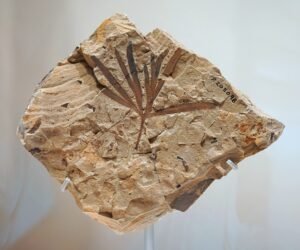
A leaf fossil of the prehistoric gymnosperm Ginkgoites australis on display at Melbourne Museum in Victoria, Australia. This specimen is from a Cretaceous deposit in Koonwarra, Victoria, Australia. https://commons.wikimedia.org/wiki/File:Ginkgoites_australis_fossil_at_Melbourne_Museum.jpg
The Koonwarra Fossil Bed was discovered during roadworks in 1961. Its finely layered sedimentary rocks preserve the remains of plants, fish, insects, crustaceans and feathers.
Scientists classify Koonwarra as a Konservat-Lagerstätte, a geological deposit remarkable for preserving fossils that would ordinarily decay before becoming part of the rock record.
The site represents an ancient freshwater lake surrounded by vegetation. Fine sediment accumulated on the lakebed, occasionally preserving delicate organisms in remarkable detail. Melbourne Museum+1
A major study published in 2025 provided an especially detailed picture of this prehistoric environment.
Researchers led by palaeobotanist Vivi Vajda examined approximately 30,000 fossil pollen grains and spores from a geological core drilled through the Koonwarra deposits. They identified 138 different types of microscopic plant remains.
The results revealed a cool-temperate landscape dominated by conifers and other ancient seed plants, with abundant ferns and clubmosses.
Most intriguingly, pollen from flowering plants accounted for approximately 1–6 per cent of the assemblage.
Although flowering plants were still a relatively small part of the vegetation, their presence confirms that the botanical revolution was already underway in southern Australia. ScienceDirect
The Ancient Trees of Gippsland
Some of the most interesting fossils from Koonwarra have scientific names that are almost as extraordinary as the plants themselves.
One is Ginkgoites australis, a plant known from distinctive fan-shaped leaves.
Its leaves resemble those of the modern ginkgo tree, Ginkgo biloba, which survives today as the sole living species of an ancient evolutionary lineage.
Ginkgo-like plants were widespread during the dinosaur era. Their leaves often had branching veins and a characteristic fan shape, making them relatively recognisable in the fossil record.
The Australian Museum holds a fossil of Ginkgoites australis from Koonwarra, providing a direct connection between southern Victoria and this remarkable group of prehistoric plants. The Australian Museum
Another fascinating plant is Brachyphyllum gippslandicum, a fossil conifer associated with the podocarp family.
Rather than producing broad leaves, conifers such as these bore specialised foliage and reproduced using cones.
The Koonwarra flora also included Taeniopteris daintreei, a plant with elongated, strap-like leaves associated with an extinct group of seed plants called pentoxylaleans.
These were not flowering plants, despite some superficial similarities in their foliage. They belonged to another branch of the complex evolutionary history of seed-bearing vegetation.
Research into Koonwarra's fossil plants has also identified fern-like foliage such as Sphenopteris warragulensis and Cladophlebis biformis, together with the horsetail Phyllotheca wonthaggiensis. CSIRO Publishing
Horsetails are particularly interesting because their modern relatives, belonging to the genus Equisetum, retain the jointed stems and distinctive structure associated with an extremely ancient plant lineage.
Imagine these plants growing around the edges of a prehistoric lake, with dense stands of ferns covering the moist ground and conifers rising above them.
It is an ecosystem that would have been recognisable in its general structure, even though many individual plants were unlike anything growing in Gippsland today.
The First Flowers: A Botanical Revolution
For much of Earth's history, flowering plants did not exist.
Forests were dominated by conifers and other seed plants, alongside ferns and their relatives. Reproduction depended on spores, cones, wind-blown pollen and other methods that had evolved long before the Cretaceous.
Then flowering plants — known scientifically as angiosperms — began to diversify.
Their defining innovation was the production of seeds enclosed within an ovary, which can develop into a fruit. Flowers provided new possibilities for reproduction, including increasingly specialised relationships with insects and other animals.
The earliest flowers were not necessarily colourful or spectacular. Many were probably small and relatively inconspicuous.
At Koonwarra, researchers have described exceptionally early flowering-plant material, including a fossil flower. These discoveries are important because they help establish when flowering plants appeared in high southern latitudes. Open Research Repository
The 2025 pollen study strengthens this picture by demonstrating that angiosperms were already present within the surrounding vegetation.
Their pollen was relatively uncommon compared with that of conifers and other gymnosperms, suggesting that flowering plants had not yet become dominant.
Yet over the following tens of millions of years, angiosperms would spread into an extraordinary variety of habitats.
They would eventually give rise to much of the vegetation familiar to modern Australians, including eucalypts, banksias, wattles and countless flowering shrubs, herbs and grasses.
The forests of Gippsland were witnessing an early stage of a transformation that would reshape the planet.
Insects: The Tiny Creatures That Changed the World
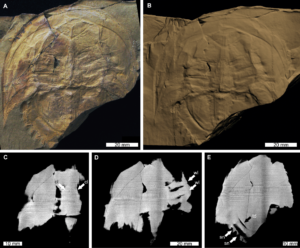
Figure 4: Victalimulus mcqueeni from the Koonwarra Fossil Bed (Early Cretaceous, Aptian). NMV P22410B, holotype. (A) Specimen under LED light. (B) 3D reconstruction of specimen, see Fig. S4. (C) X-ray tomographic slice showing cardiac lobe (white arrows). (D) X-ray tomographic slice showing walking leg impressions (white arrows). (E) X-ray tomographic slice showing fixed spines and moveable spine notches (white arrows) and thoracetronic doublure (black arrow). Abbreviations: cl, cardiac lobe; sn, spine notches; td, thoracetronic doublure; wl, walking leg impression. Image credit: (A) Frank Holmes. Image in (A) reproduced from Bicknell & Pates (2020) under a CC BY 4.0 license. 3D PDF found at 10.17605/OSF.IO/AT528. Raw reconstructed slices found at 10.17602/M2/M392556.
Long before bees visited flowers, insects were already feeding on plants, consuming pollen, hunting other insects and living in freshwater habitats.
The Koonwarra Fossil Bed provides an extraordinary record of these small but important creatures.
Among the most fascinating is Koonwarraphis rotundafrons, a tiny prehistoric aphid described by researchers in 2016.
Aphids are familiar today as small insects that feed on plant sap. Their Cretaceous relatives were already exploiting the vegetation of ancient Gondwana.
The fossil is especially significant because it represents the first Cretaceous aphid formally recorded from eastern Gondwana.
Its mouthparts suggest that it may have fed on soft, herbaceous plants. Researchers have proposed that early flowering plants could have been among its hosts, although this remains a possibility rather than a proven relationship. biotaxa.org
Other insects preserved at Koonwarra include beetles, flies and aquatic insect forms.
These creatures occupied different parts of the food web. Some fed on vegetation or decaying material. Others hunted smaller invertebrates. Aquatic insects spent part or all of their lives in the lake and surrounding waterways.
The presence of such varied insect life suggests that the ancient forest was a complex ecosystem, with many of the ecological relationships familiar today already established.
The Strange Case of the Prehistoric Flea
One of Koonwarra's most intriguing fossil insects is Tarwinia australis, an early flea-like insect.
Modern fleas are specialised parasites that feed on the blood of mammals and birds. Their prehistoric relatives provide clues about the evolution of parasitism.
The discovery of flea-like fossils in Cretaceous Victoria raises an interesting question: what animals might they have fed upon?
Small mammals were already present in Australia during the Early Cretaceous, and feathered dinosaurs and early birds formed part of the wider southern ecosystem.
However, a fossil flea cannot tell us exactly which animal served as its host.
What it does reveal is that relationships between animals and parasites were already developing in the ancient forests of southern Gondwana.
These tiny creatures remind us that prehistoric ecosystems were not simply collections of dinosaurs and enormous trees. They contained complex communities of insects, microorganisms, parasites, predators and scavengers.
Life Beneath the Water
The freshwater lake at Koonwarra also supported an unusual collection of aquatic invertebrates.
Among them was Victalimulus mcqueeni, a prehistoric horseshoe crab.
Despite their name, horseshoe crabs are more closely related to spiders and scorpions than to true crabs. Their evolutionary history stretches back hundreds of millions of years.
The Koonwarra discovery is particularly interesting because horseshoe crabs are generally associated with marine environments, whereas this fossil was preserved in freshwater sediments.
Another fossil, Koonaspides indistinctus, belonged to a group of small freshwater crustaceans known as syncarids.
These animals occupied the lake environment alongside fish and aquatic insects, contributing to a food web that supported larger predators.
Together, the fossils reveal an ecosystem in which life flourished above and below the water's surface.
Surviving the Polar Seasons
One of the most remarkable aspects of Cretaceous Gippsland was its geographical position.
Australia was still connected to Antarctica, and southern Victoria lay at a much higher latitude than it does today.
This meant long summer days and extended periods of winter darkness.
The climate was generally warmer than modern Antarctica, but seasonal conditions could still be challenging.
Scientists have investigated whether Koonwarra's lake experienced winter freezing. Earlier interpretations suggested that seasonal ice formation may have contributed to the preservation of fish and other organisms, although aspects of this interpretation remain debated.
The more recent pollen evidence supports a cool-temperate environment with vegetation adapted to pronounced seasonal changes. ScienceDirect
Plants growing in this environment faced a difficult annual cycle.
During summer, extended daylight provided opportunities for growth. During winter, low light and cooler temperatures reduced photosynthesis.
Some ancient plants may have shed their leaves seasonally, while others retained evergreen foliage.
These adaptations helped vegetation survive at high southern latitudes and supported the animals living among it.
Tarra-Bulga: A Living Connection to Gondwana
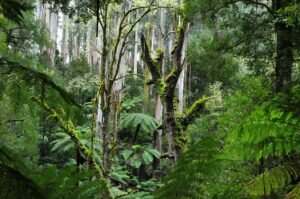 Today, the forests of Tarra-Bulga National Park offer one of the most accessible ways to appreciate Gippsland's botanical history.
Walk beneath the towering mountain ash and into the sheltered gullies, and the vegetation changes.
Soft tree ferns arch over walking tracks. Mosses cover fallen timber. Myrtle beech grows in cool, moist locations, while liverworts and other small plants occupy the damp forest floor.
The modern forest is not a preserved Cretaceous ecosystem. Its species and ecological relationships have evolved through millions of years of climatic and geological change.
Nevertheless, some of its plants belong to lineages with extraordinarily ancient histories.
Tree ferns are descendants of plant groups that flourished long before flowering plants became widespread.
Myrtle beech, Nothofagus cunninghamii, belongs to a southern plant lineage with deep Gondwanan connections, although the history of the modern species is much younger than the earliest Cretaceous forests.
Mosses and liverworts represent even older branches of land-plant evolution.
These connections make Tarra-Bulga a particularly valuable place for understanding how ancient botanical lineages persist within changing environments.
From the Strzeleckis to Port Albert
The fossil evidence from Koonwarra and the Strzelecki Group also provides clues about the prehistoric environments of the wider Gippsland region.
Although we cannot identify the exact plants that grew at the present-day sites of Yarram, Tarra-Bulga or Port Albert 115 million years ago, the regional geology allows us to reconstruct the broader landscape.
Much of southern Victoria was occupied by river systems, lakes, floodplains and forested environments associated with the developing Gippsland Basin.
The sediments accumulating in these environments preserved plant remains that would eventually become part of the geological record.
As Australia gradually separated from Antarctica, the region continued to change. Ancient forests were replaced by new plant communities, coastlines shifted, and sediment accumulated in the expanding basin.
Some of the organic material deposited during the Cretaceous and subsequent periods would eventually contribute to the formation of the petroleum systems beneath Bass Strait.
Much later, extensive swamp forests in the Latrobe Valley would produce the enormous brown coal deposits for which the region became famous.
The plants of prehistoric Gippsland therefore helped shape not only the region's natural history but also its geological resources.
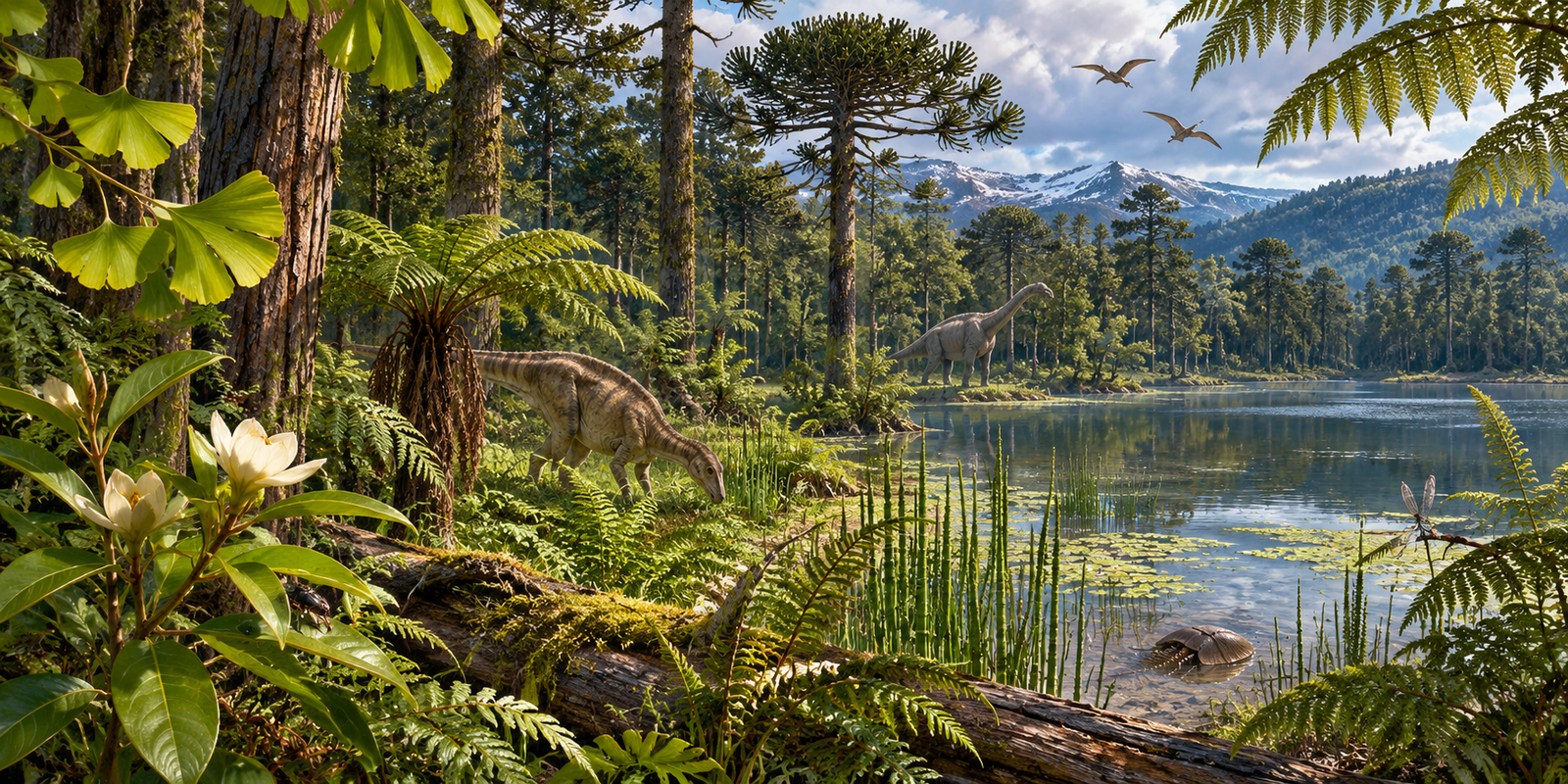
Artists impression
The Forest That Changed the World
It is easy to overlook plants when imagining the age of dinosaurs.
The enormous reptiles attract attention, while the vegetation surrounding them often becomes little more than scenery.
Yet the botanical changes of the Cretaceous were among the most important events in the history of life.
The rise of flowering plants transformed relationships between plants and animals. New food sources appeared, new habitats developed, and increasingly specialised interactions emerged between insects and vegetation.
The fossil record of Koonwarra captures part of that transformation at a remarkable moment in Earth's history.
More than 110 million years later, its delicate fossil leaves, pollen grains and insects continue to reveal how the world we know began to take shape.
The next time you walk through Tarra-Bulga, drive across the green hills near Yarram or look towards the coast at Port Albert, consider the forests that existed here long before the familiar Australian bush.
Beneath the modern landscape lies the story of a botanical revolution — one that began in the age of dinosaurs and continues in every flowering plant growing around us today.